
How studying the wrong topic for an exam taught me the smartest way to study anything
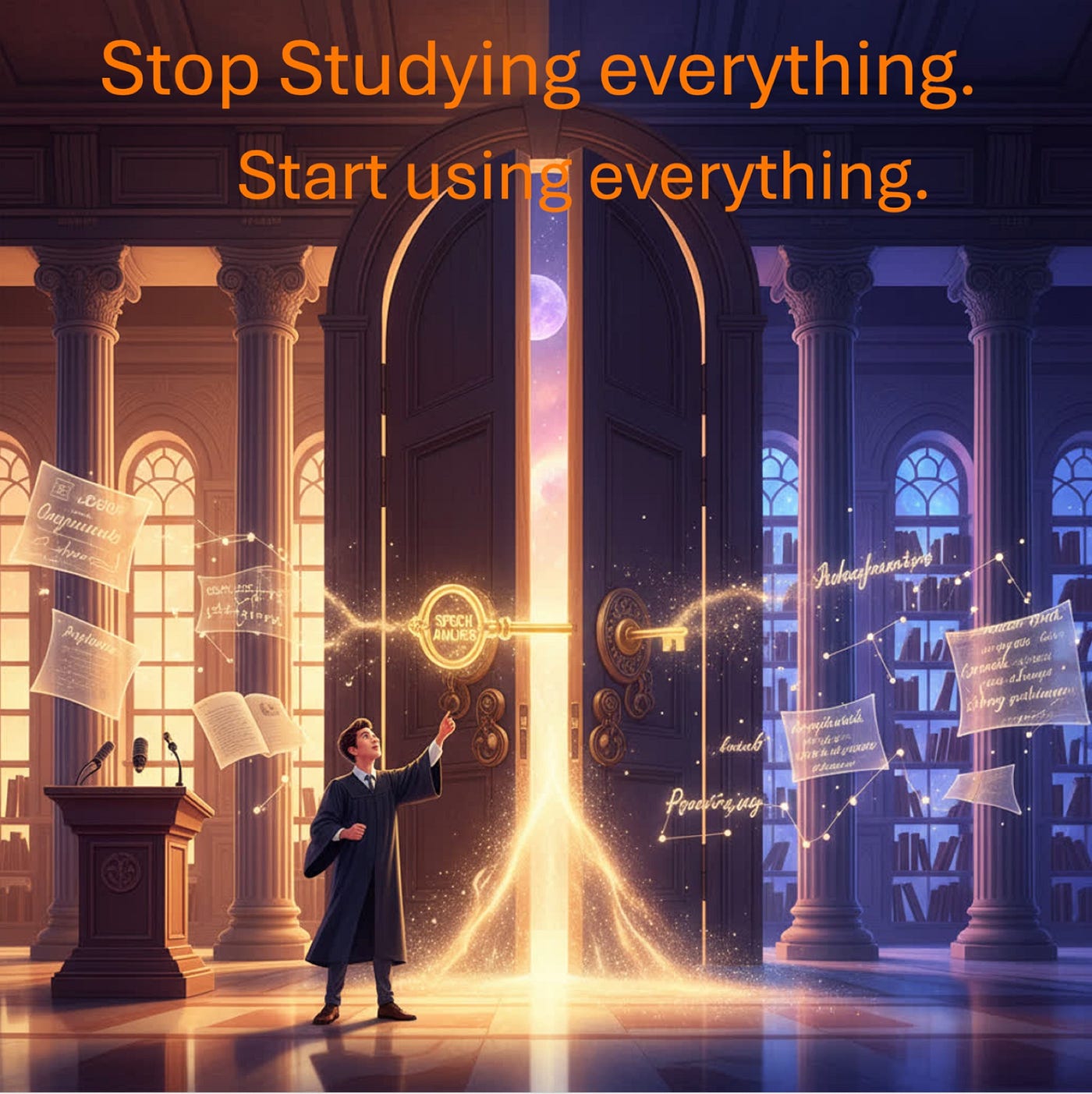
How are you meant to learn and ace 15+ subjects in school while every teacher grades you like you‘re supposed to be an expert in each one?
Is that even possible without studying overtime and having no free time anymore?
Yes. It is. But only if you connect those different subjects with what I call Reverse Application.
Let me tell you a story so it becomes clear what I mean by that:
I recently graduated high school
and in my language finals,
I studied everything for speech analysis;
All the stylistic devices, the different kinds of arguments, all the rhethorical strategies …
But when test day came, I opened the paper and saw:
Poem analysis.
It was a poem about adventure in nature.
Now all that studying felt wasted.
So what happened is I tried to apply everything I studied from speech analysis to poem analysis so that I could at least say something and save my grades,
and it worked:
I noticed how towards the end of the poem,
the intensity of feelings were build up to a climax,
just like arguments in a speech are organized from weakest to strongest!
I noticed that because at the beginning, words like „earth“ and „house“ were used while towards the end, words like „the heavens“ and „god“ were used.
In the same way, I recognized how in the second verse,
the speaker would weaken the opposite feeling of wanting to stay at home
and not go out into nature by saying „the one who stays at home doesn‘t see the sunrise“.
That‘s the same rhethorical tactic used in speeches when the speaker invalidates the counter-arguments.
Only here it wasn‘t counter-arguments, but counter-emotions 😉
And it went on and on and on …
I reversed everything I knew and understood about speech analysis and applied it to this poem;
That‘s why I call it reverse application 😉
And as a result, I passed the test I would have otherwise failed.
While I didn‘t ace the test, I saved it. I passed it.
Now imagine what this could do if you didn‘t apply it accidentally, but purposefully:
For example, circling back to our question at the beginning:
You can connect all the different subjects in school by not focusing on the exact contents of each subject,
but on the underlying skills that connect them:
- how you learn a language applies to all foreign languages you learn in school
- Recognizing patterns works across all subjects too: From the historical patterns that repeat themselves to patterns of how you can approach math problems
- In all analysis, whether it‘s a cartoon analysis or a speech or a poem analysis, you always go from
- – description ( what do you see? What is being said? … )
- – to analysis ( what does that mean? What is the effect of this rhethorical device? What does this symbol represent? … )
- – to interpretation ( what is the message behind it all? )
- – to judgement / conclusion ( was the author succesful in reaching his / her goal? Was your initial hypothesis about what the poem is about correct? How does this piece of literature relate to other pieces of writing? … )
- -> So learn the skills for all 4 components of this structure once, and you can apply it to any analysis of literature that you have to make in any subject; English, Politics, History, …
And what I think is the most powerful use of this technique is:
You could reverse-apply your natural strength that you already have from your hobbies to the subjects you struggle with in school.
You can find analogies to explain how for example math equations work
with the sports or instruments or video games you play.
All in all:
You can understand something by realizing it works the same way as something else you already know.
So give it a shot:
Next time you struggle with a math problem or any subject in school you don‘t understand, ask yourself:
Have I already done this in a different situation?
Is this like something I already know from another subject?
Does this work like a hobby I play?
And if that‘s a little difficult or confusing to you,
I have developped an intuitive step by step process that helps you
find these analogies and make those reverse-applications
in my eBook.
It comes with an Ai tool,
a so called SuperPrompt that you can copy and paste into any new Ai chat:
And it doesn’t cause brainrot by replacing your thinking,
but it will ask you some questions about your hobbies and subjects you’re good at
and the task or subject you struggle with right now,
and it helps you apply this technique of Reverse-Application to your specific situation.
In other words;
It doesn‘t take the thinking and skills away from you, but builds them with you 😉
So you can read the full guide for an in-depth understanding
or learn to apply the technique directly and interactively with the SuperPrompt I created for you 😉
It‘s both included in the eBook above!
Thanks for reading!
If you have any questions about this technique
or anything else related to school and studying smarter,
feel most free and invited to ask them in the comments below!