
Maybe you lost the client you were counting on to make rent this month.
Maybe you spent months building a launch and it landed with almost nobody noticing.
There’s a Chinese story that’s been passed down for over two thousand years, and it goes right at this feeling.
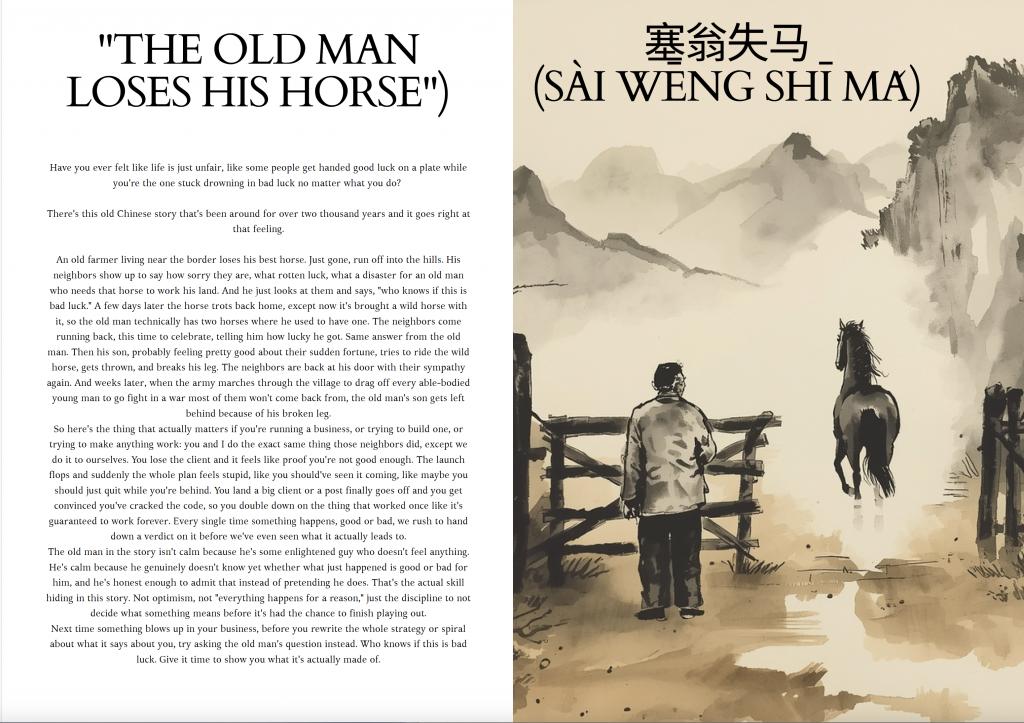
An old farmer living near the border loses his best horse. It just runs off into the hills one day.
His neighbors show up to tell him how sorry they are, what rotten luck for an old man who needs that horse to work his land.
He just looks at them and says, “who knows if this is bad luck.” A few days later the horse comes back, except now it’s brought a second, wild horse along with it.
The neighbors rush over again, this time to celebrate his good fortune. He gives them the same answer. Then his son, feeling pretty good about their sudden luck, tries to ride the wild horse, gets thrown off, and breaks his leg. More sympathy from the neighbors.
Weeks later the army marches through the village to draft every able-bodied young man into a war most of them won’t come back from. The old man’s son stays home, because of the broken leg.
Here’s the part that actually matters if you’re the one making the calls in your own business, whatever that looks like for you.
Whether you’re a freelancer whose whole income depends on whoever’s next in the pipeline, or a coach whose entire product is your own judgment,
or a founder watching a launch die in real time, or a manager who just lost someone you actually trusted,
or someone in sales replaying a deal that slipped away right at the finish line, you’re probably doing the exact same thing those neighbors did, except you’re doing it to yourself.
Deciding what a win or a loss means before you’ve had any real chance to see what it actually turns into.
The old man isn’t calm because nothing bothers him. He’s calm because he genuinely doesn’t know yet whether what just happened is good or bad for him, and he’s honest enough to sit in that not-knowing instead of rushing to fill in the blank.
That’s the actual skill hiding in this story. Not some forced silver lining, just the patience to not decide what something means before it’s had time to finish playing out.
Knowing this doesn’t make the sting go away, and it shouldn’t have to. What actually helps is having something to do with that feeling instead of just marinating in it or reacting straight out of panic.
That’s why I built a free tool around this story: fifteen real situations that hit freelancers, creatives, coaches, founders, managers, and salespeople specifically, each one paired with a simple way to work through it before you make any big decision off the back of it.