
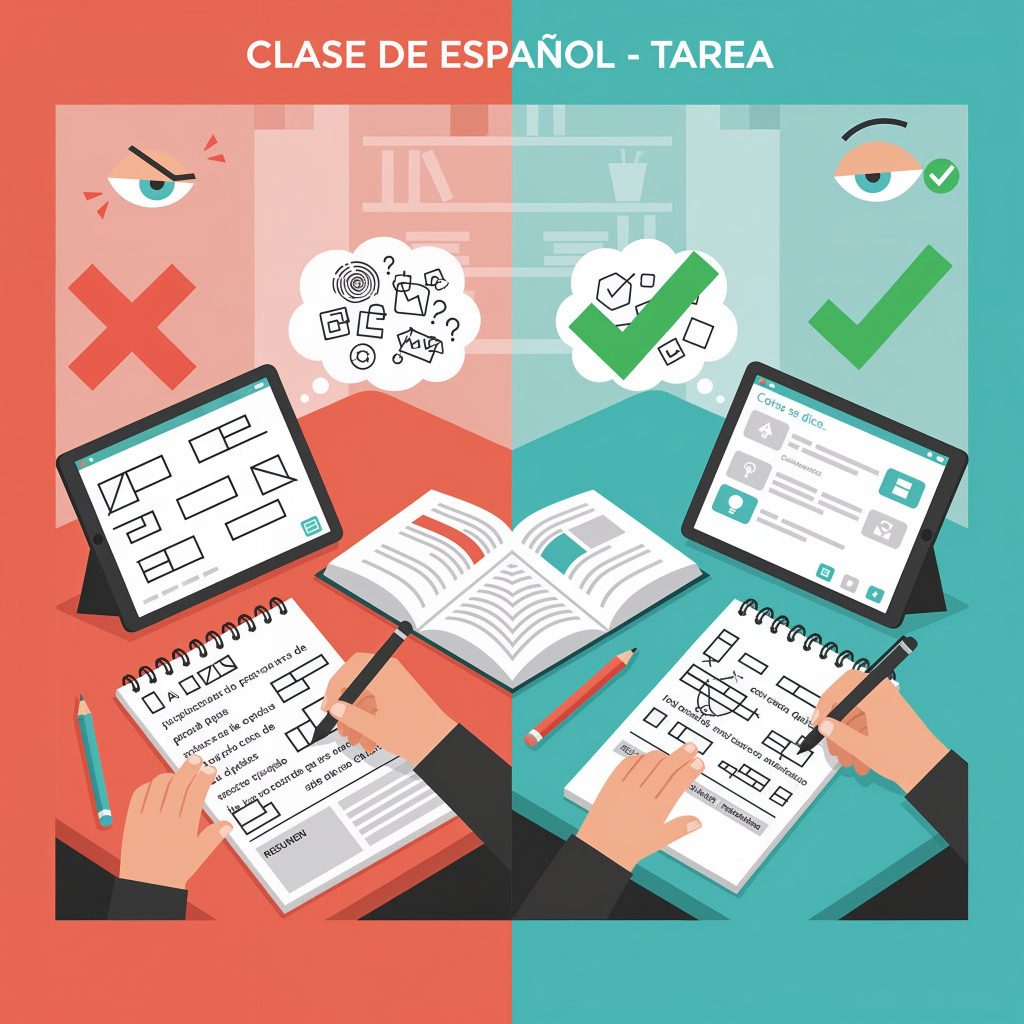
I had a Spanish assignment due: write a one-page summary of Chapter 3 in Spanish.
Problem: My Spanish was terrible. I could barely form a sentence. There was no way I could write a full page.
So I did what everyone does now: I opened ChatGPT.
“Write a one-page summary of this chapter in Spanish.” Pasted the chapter. Hit enter.
ChatGPT wrote a perfect summary in Spanish. Complex sentences. Proper grammar. Advanced vocabulary I’d never heard of.
I copied it. Turned it in.
Got an A.
Easy.
Then My Teacher Called Me Out
Next class, Señora Martinez asked me to stay after.
“Your summary was very good,” she said. “Can you read the first paragraph out loud for me?”
I looked at the paper. I could barely pronounce the words. Stumbled through the first sentence.
She stopped me. “Did you write this?”
“Yes,” I lied.
“Okay. Can you explain what this sentence means?” She pointed to a complex sentence with subjunctive tense I’d never learned.
I stared at it. I had no idea.
“I… I used a grammar guide?”
She looked at me. We both knew.
“Next assignment,” she said, “I want to see work that matches your Spanish level. Understood?”
I wasn’t officially caught. But she knew. And I knew she knew.
More importantly: I’d gotten an A and learned absolutely nothing. My Spanish was still terrible.
The Problem With How Everyone Uses AI
Here’s how most students use AI for school:
For writing assignments: “Write my essay about symbolism in The Great Gatsby” AI writes it. Student copies it. Submits.
For problem sets: “Solve these 20 calculus problems for me”
AI solves them. Student copies answers. Submits.
For language homework: “Translate this English paragraph to Spanish” AI translates. Student copies. Submits.
Perfect homework scores. Zero learning. Then test day comes and you can’t do anything without AI.
Or worse: teacher asks you to explain your work and you can’t. Because it’s not your work. It’s AI’s work.
That’s what happened to me with Spanish. I could’ve kept using AI to write my summaries. Maybe Señora Martinez wouldn’t have called me out. Maybe I would’ve kept getting As.
But I still wouldn’t be able to speak Spanish. When oral exams came, I’d fail. When class discussions happened, I’d be silent.
I was using AI to fake competence. Not to build actual competence.
The Turning Point
After that conversation, I had a choice:
Option 1: Stop using AI entirely. Go back to struggling, spending hours on assignments, getting Cs and Ds.
Option 2: Keep using AI to cheat. Be more careful. Hope I don’t get caught again.
Option 3: Figure out if there’s a way to use AI that actually helps me get better at Spanish.
I tried Option 3.
Next assignment was another chapter summary. But this time I tried something different.
Instead of asking AI to write the summary for me, I asked:
“I need to write a summary of this chapter in Spanish, but my Spanish isn’t good enough yet. Can you help me understand what happened in the chapter so I can write about it in Spanish myself?”
ChatGPT: “Sure! I’ll summarize the chapter in English for you, and we can work on how you’d express those ideas in Spanish at your level.
Chapter 3 Summary (in English):
- María discovers the secret garden behind the house
- She finds it’s been abandoned for years
- She decides to restore it without telling anyone
- She starts cleaning up the plants and planning what to plant
Now, what’s your current Spanish level? That way I can help you express these ideas with vocabulary and grammar you actually know.”
Me: “I’m in Spanish 2. I know present tense pretty well, some past tense. I don’t know subjunctive or fancy stuff.”
ChatGPT: “Perfect. Let’s build your summary using what you know. Let’s start with the first point – María discovers the garden. How would you say ‘María discovers the garden’ in Spanish?”
Me: “María descubre el jardín?”
ChatGPT: “Good! That works. Now add ‘secret’ and ‘behind the house.’ Do you know those words?”
Me: “Secreto… and… detrás de la casa?”
ChatGPT: “Exactly right. So: ‘María descubre el jardín secreto detrás de la casa.’ Now you try the next part – how would you say the garden has been abandoned?”
I worked through the whole summary this way. ChatGPT didn’t write it for me. It helped me figure out how to say what I wanted to say in Spanish, using words and grammar I actually knew.
My final summary looked like this:
Mi Resumen – Capítulo 3
María descubre el jardín secreto detrás de la casa grande. El jardín está abandonado por muchos años. Hay plantas silvestres y una fuente antigua en el centro. María piensa que el jardín es muy especial. Ella decide limpiar el jardín y plantar flores nuevas. María no dice nada a otras personas sobre el jardín. Es su secreto. Ella visita el jardín cada día y trabaja en las plantas.
It wasn’t fancy. It wasn’t perfect Spanish. But it was MY Spanish. Using words I knew. Grammar I understood.
I could read it out loud. I could explain what each sentence meant. I could answer questions about it.
Because I actually wrote it.
The Difference Between Cheating and Learning
Turned that summary in. Got a B+.
Not an A like last time. But Señora Martinez wrote at the top: “Much better! This shows real understanding. Keep working on past tense.”
She could tell this was actually my work. And I could defend it because I understood every word.
More importantly: my Spanish got better. Because I’d practiced writing in Spanish, not practiced copying AI.
That’s when I understood the difference:
Using AI to cheat:
- AI does the work
- You copy it
- You learn nothing
- Can’t explain it
- Get caught or fail when AI isn’t there
Using AI to learn:
- AI explains concepts
- AI helps you understand
- YOU do the work
- You can explain everything
- You get better over time
The line is simple: If you can’t explain your work, you’re doing it wrong.
The Golden Rule
After that experience, I developed one rule for using AI:
If you can’t explain it, you didn’t learn it.
Before submitting anything created with AI help, I ask myself three questions:
- Can I explain my process?
- How did I approach this?
- What steps did I take?
- Why did I make the choices I made?
- Can I defend my choices?
- Why did I use this word/method/argument?
- What other options did I consider?
- Why is this the best approach?
- Could I do similar work without AI?
- If teacher gave me a similar assignment right now, could I do it?
- Am I getting better or staying dependent?
If the answer to ANY of these is “no,” I’m using AI wrong.
Let me show you what this looks like in practice:
Examples: Cheating vs. Learning
SPANISH (Language Learning)
Wrong way: “Translate this paragraph to Spanish for me” → AI translates → You copy → You can’t speak Spanish
Right way: “I need to write about this topic in Spanish. Can you summarize the main points in English, then help me express them using Spanish 2 vocabulary I actually know?” → AI summarizes in English → AI helps YOU write in Spanish using your level → You practice actual Spanish → You get better
MATH (Problem Solving)
Wrong way: “Solve these calculus problems for me” → AI solves them → You copy answers → You can’t do calculus
Right way: “I don’t understand how to approach this type of problem. Can you explain the concept and show me the method with a simple example, then I’ll try my problem?” → AI explains concept → AI shows method with example → YOU solve your problem → You learn calculus
ENGLISH (Essay Writing)
Wrong way: “Write an essay about symbolism in The Great Gatsby” → AI writes essay → You copy it → You can’t analyze literature
Right way: “I’m brainstorming arguments about the green light symbol. I have three ideas: [your ideas]. Can you suggest 3 more angles I could explore?” → AI suggests more ideas → YOU choose which to develop → YOU write the essay → You learn to analyze
See the pattern? AI helps you understand. YOU do the work.
What Happened With Spanish
I kept using this approach for every Spanish assignment. Not asking AI to write for me, but asking AI to help me write in Spanish myself.
Some specific things I did:
For vocabulary: Instead of: “What’s the Spanish word for X?” I asked: “I want to say [concept] but I only know Spanish 2 vocabulary. What’s a simple way to express this?”
For grammar: Instead of: “Fix my grammar mistakes” I asked: “I wrote this sentence but I’m not sure about the verb conjugation. Is ‘visitó’ or ‘visita’ correct here and why?”
For speaking practice: Instead of: Nothing (couldn’t practice speaking with AI before) I started: Having simple conversations in Spanish with ChatGPT, getting corrections on my mistakes, learning the right patterns
My Spanish improved FAST. Faster than it had all year.
Not because AI was doing my work. Because AI was helping me practice more effectively.
By the end of the semester:
- I could have basic conversations in Spanish
- I could write summaries without help
- I passed oral exams
- I actually understood grammar instead of faking it
Señora Martinez noticed. Last day of class she told me: “Whatever you changed this semester, keep doing it. Your Spanish has improved more in three months than the whole year before.”
I was using AI. But I was using it to get better, not to cheat.
The Paper Trail That Protects You
Here’s something else I learned: save your AI conversations.
Every time I used ChatGPT to help with Spanish, I kept the chat. If anyone ever questioned whether I cheated, I had proof of exactly what I asked AI to do.
My chat history showed:
- Me asking for English summaries of chapters
- Me asking how to express ideas in simple Spanish
- Me writing sentences and asking if grammar was correct
- Me practicing and getting corrections
It showed I was learning, not cheating.
That paper trail is your protection. If a teacher questions your work, you can show:
- You asked AI for understanding, not answers
- You did the actual work yourself
- You can explain everything because you learned it
No paper trail? That’s a red flag. Because if you were using AI ethically, you’d have conversations showing you learning.
If You’re Using AI for School
If you’re using AI for homework or studying:
Ask yourself: Am I using this to learn or to cheat?
Signs you’re cheating:
- AI does the work, you copy it
- You can’t explain what you submitted
- You’re getting worse at the subject (more dependent on AI)
- No paper trail of learning conversations
- Scared to show your AI chats
Signs you’re learning:
- AI helps you understand, you do the work
- You can explain everything you submit
- You’re getting better at the subject (less dependent on AI)
- Paper trail shows learning conversations
- Comfortable showing your AI chats because they prove you learned
One makes you stupid. One makes you smarter.
Choose which one you want to be.
The Tool That Keeps You Honest
The SuperPrompt is designed to stop you from cheating yourself.
When you ask it to do your work, it refuses: “You’re asking me to do the thinking. That’s what you need to practice.”
Then it helps you learn the concept so you can do the work yourself.
It also handles other study situations: understanding confusing textbooks, getting practice feedback, learning when teachers won’t teach, cramming effectively, and much more!
Think of it like having a tutor who won’t let you cheat – even when you’re tempted.
Plus the complete guide showing how to use AI ethically for every situation – what crosses the line, what doesn’t, how to stay safe.
Both designed so you can use AI to get better, not to fake being better.
Ready to use AI the right way?
P.S. Before you submit your next AI-assisted assignment, ask yourself: Can I explain this entire thing to my teacher right now? If not, you’re not done learning yet.
If you enjoyed this Blog Post, you might also enjoy my other Blogs on Meta Learning ( i.e. learning how to learn ) here: